Ink Sampler Box: Wonders of the World
Originally available as part of our July 2025 Ink Subscription Box, 30ml samples of our best selling collection- Cult Pens x Diamine 7 Wonders of the World. 7 Samples + an on theme Legami pencil made from recycled newspaper.
Colosseum: Travertine limestone is one of the three main building materials used to construct the colosseum along with tuff and brick-faced concrete. The travertine limestone was used to construct the pillars, ground floor and external wall, as well as much of the seating in the interior. It's a beautiful sandy brown colour and we loved it, so we made an ink that looks like it!
Taj Mahal : Two notable decorative features are repeated throughout the Taj Mahal: Pietra dura and Arabic calligraphy. Arabic calligraphy is prevalent on the arched entrances to the mausoleum proper. Pietra dura incorporates the inlay of semiprecious stones, including lapis lazuli which we've taken inspiration from with this colour.
Petra : Once a major regional trading hub due to its proximity to the incense trade route, the ancient sandstone-carved city of Petra is found in Southern Jordan, adjacent to the mountain of Jabal Al-Madbah. The beautiful pink hue of the sandstone rock inspired the colour of this ink.
Chichen Itza was a pre-Columbian city constructed by the Mayans in modern day Mexico. Once a major focal point in the Northern Maya Lowlands, Chichen Itza is one of the largest cities built by the Mayans and is believed to have been one of the mythical great cities (Tollans) referred to in later Mesoamerican literature. Chichen Itza is a beautiful blue-grey inspired by the Grey Limestone blocks used to construct the ancient pyramids, temples, columned arcades and other stone structures found at Chichen Itza.
Machu Picchu is an Inca citadel located in the Eastern Cordillera of southern Peru. It's one of the most recognisable names associated with Inca history and remained undiscovered by the western world right up until 1902 when it was discovered by Agustín Lizárraga but didn't become popularised until Hiram Bingham came across the site in 1911. The green colour of the Machu Picchu ink is inspired by the Huayna Picchu Mountain Range, which is home to Machu Picchu.
Christ the Redeemer: Probably the most recognisable man-made structure in South America and one of the most recognisable structures in the world, Christ the Redeemer is an Art Deco statue of Jesus Christ located in Rio de Janeiro. It was constructed by Heitor da Silva Cost and Paul Landowski in collaboration with Albert Caquot and Gheorghe Leonida in 1931. It's made of reinforced concrete - which has inspired the grey colour from this ink - and soapstone.
The Great Wall of China: Made up of multiple sections of defensive walls, the Great Wall of China is a remarkable feat of engineering. The wall is 21,196km long with construction beginning as early as the 7th century BC right up until the Ming dynasty, which ended in 1644. The wall was mainly built from rammed earth, stones and wood but later, during the Ming dynasty, construction materials included bricks, tiles and lime. We thought a muddy green colour matches the characteristics of the wall well, so we've gone with that for the ink!
Full size bottles of all the samples included are available here.
Product Information
Product Information
Shipping & Returns
Shipping & Returns



Ink Sampler Box: Wonders of the World
Ink Sampler Box: Wonders of the World
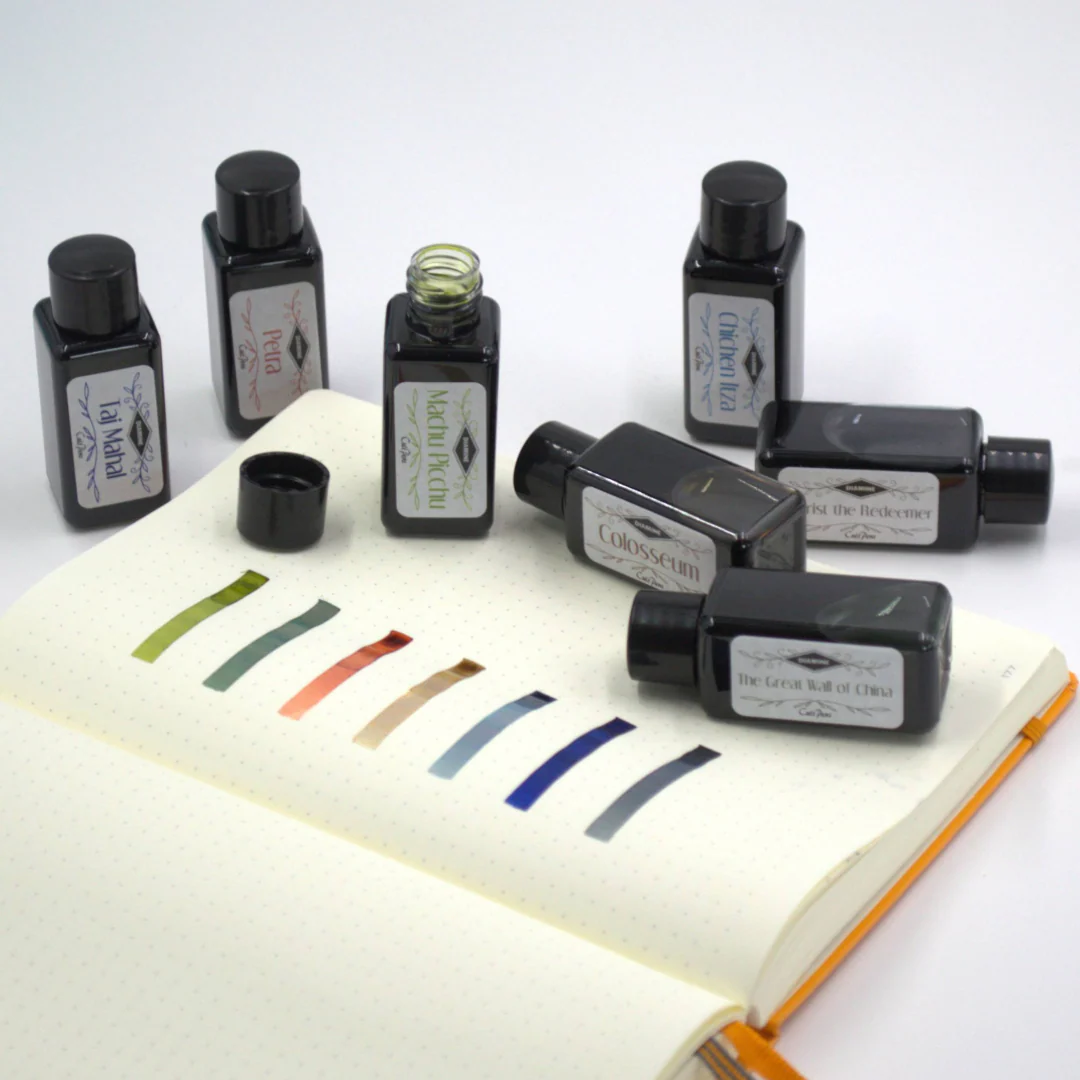
Originally available as part of our July 2025 Ink Subscription Box, 30ml samples of our best selling collection- Cult Pens x Diamine 7 Wonders of the World. 7 Samples + an on theme Legami pencil made from recycled newspaper.
Colosseum: Travertine limestone is one of the three main building materials used to construct the colosseum along with tuff and brick-faced concrete. The travertine limestone was used to construct the pillars, ground floor and external wall, as well as much of the seating in the interior. It's a beautiful sandy brown colour and we loved it, so we made an ink that looks like it!
Taj Mahal : Two notable decorative features are repeated throughout the Taj Mahal: Pietra dura and Arabic calligraphy. Arabic calligraphy is prevalent on the arched entrances to the mausoleum proper. Pietra dura incorporates the inlay of semiprecious stones, including lapis lazuli which we've taken inspiration from with this colour.
Petra : Once a major regional trading hub due to its proximity to the incense trade route, the ancient sandstone-carved city of Petra is found in Southern Jordan, adjacent to the mountain of Jabal Al-Madbah. The beautiful pink hue of the sandstone rock inspired the colour of this ink.
Chichen Itza was a pre-Columbian city constructed by the Mayans in modern day Mexico. Once a major focal point in the Northern Maya Lowlands, Chichen Itza is one of the largest cities built by the Mayans and is believed to have been one of the mythical great cities (Tollans) referred to in later Mesoamerican literature. Chichen Itza is a beautiful blue-grey inspired by the Grey Limestone blocks used to construct the ancient pyramids, temples, columned arcades and other stone structures found at Chichen Itza.
Machu Picchu is an Inca citadel located in the Eastern Cordillera of southern Peru. It's one of the most recognisable names associated with Inca history and remained undiscovered by the western world right up until 1902 when it was discovered by Agustín Lizárraga but didn't become popularised until Hiram Bingham came across the site in 1911. The green colour of the Machu Picchu ink is inspired by the Huayna Picchu Mountain Range, which is home to Machu Picchu.
Christ the Redeemer: Probably the most recognisable man-made structure in South America and one of the most recognisable structures in the world, Christ the Redeemer is an Art Deco statue of Jesus Christ located in Rio de Janeiro. It was constructed by Heitor da Silva Cost and Paul Landowski in collaboration with Albert Caquot and Gheorghe Leonida in 1931. It's made of reinforced concrete - which has inspired the grey colour from this ink - and soapstone.
The Great Wall of China: Made up of multiple sections of defensive walls, the Great Wall of China is a remarkable feat of engineering. The wall is 21,196km long with construction beginning as early as the 7th century BC right up until the Ming dynasty, which ended in 1644. The wall was mainly built from rammed earth, stones and wood but later, during the Ming dynasty, construction materials included bricks, tiles and lime. We thought a muddy green colour matches the characteristics of the wall well, so we've gone with that for the ink!
Full size bottles of all the samples included are available here.
Original: $35.02
-65%$35.02
$12.26Product Information
Product Information
Shipping & Returns
Shipping & Returns
Description
Originally available as part of our July 2025 Ink Subscription Box, 30ml samples of our best selling collection- Cult Pens x Diamine 7 Wonders of the World. 7 Samples + an on theme Legami pencil made from recycled newspaper.
Colosseum: Travertine limestone is one of the three main building materials used to construct the colosseum along with tuff and brick-faced concrete. The travertine limestone was used to construct the pillars, ground floor and external wall, as well as much of the seating in the interior. It's a beautiful sandy brown colour and we loved it, so we made an ink that looks like it!
Taj Mahal : Two notable decorative features are repeated throughout the Taj Mahal: Pietra dura and Arabic calligraphy. Arabic calligraphy is prevalent on the arched entrances to the mausoleum proper. Pietra dura incorporates the inlay of semiprecious stones, including lapis lazuli which we've taken inspiration from with this colour.
Petra : Once a major regional trading hub due to its proximity to the incense trade route, the ancient sandstone-carved city of Petra is found in Southern Jordan, adjacent to the mountain of Jabal Al-Madbah. The beautiful pink hue of the sandstone rock inspired the colour of this ink.
Chichen Itza was a pre-Columbian city constructed by the Mayans in modern day Mexico. Once a major focal point in the Northern Maya Lowlands, Chichen Itza is one of the largest cities built by the Mayans and is believed to have been one of the mythical great cities (Tollans) referred to in later Mesoamerican literature. Chichen Itza is a beautiful blue-grey inspired by the Grey Limestone blocks used to construct the ancient pyramids, temples, columned arcades and other stone structures found at Chichen Itza.
Machu Picchu is an Inca citadel located in the Eastern Cordillera of southern Peru. It's one of the most recognisable names associated with Inca history and remained undiscovered by the western world right up until 1902 when it was discovered by Agustín Lizárraga but didn't become popularised until Hiram Bingham came across the site in 1911. The green colour of the Machu Picchu ink is inspired by the Huayna Picchu Mountain Range, which is home to Machu Picchu.
Christ the Redeemer: Probably the most recognisable man-made structure in South America and one of the most recognisable structures in the world, Christ the Redeemer is an Art Deco statue of Jesus Christ located in Rio de Janeiro. It was constructed by Heitor da Silva Cost and Paul Landowski in collaboration with Albert Caquot and Gheorghe Leonida in 1931. It's made of reinforced concrete - which has inspired the grey colour from this ink - and soapstone.
The Great Wall of China: Made up of multiple sections of defensive walls, the Great Wall of China is a remarkable feat of engineering. The wall is 21,196km long with construction beginning as early as the 7th century BC right up until the Ming dynasty, which ended in 1644. The wall was mainly built from rammed earth, stones and wood but later, during the Ming dynasty, construction materials included bricks, tiles and lime. We thought a muddy green colour matches the characteristics of the wall well, so we've gone with that for the ink!
Full size bottles of all the samples included are available here.